How MSPs can use downtime costs to drive client conversions
In today‘s always-on digital world, downtime is a risk that businesses can’t afford to ignore. Even a few hours offline can drastically impact revenue, productivity and reputation. The stakes are even higher for sectors with strict regulatory and compliance requirements — including federal, state and local government, health care, finance, legal, education and retail — where every minute of disruption carries significant financial and legal consequences.
For MSPs, this heightened risk presents a clear opportunity. Clients face data threats more frequently than ever and need solutions that go beyond traditional backups and deliver business continuity. However, while the need is real, making clients understand the true cost of downtime in practical terms remains a significant challenge. Many businesses still view backup and recovery as a technical checkbox, rather than a business-critical strategy.
This blog will help MSPs like you shift that perspective. We’ll explore how to use data and real-world impact to highlight the true cost of downtime. You’ll get practical ways to reframe the conversation — from selling backup storage to delivering uptime and operational continuity. We’ll also show how Datto BCDR helps MSPs protect client data and keep their businesses running with a platform built specifically for operational resilience.
What is downtime, and why must MSPs quantify its cost?
Downtime refers to any period when systems, applications or networks are unavailable or underperforming. It creates immediate disruptions that ripple across the organization by delaying internal workflows, disrupting customer interactions and bringing business operations to a standstill. Even short outages reduce productivity, impact user experience and lead to financial and reputational loss.
To effectively communicate the impact of downtime, MSPs need to shift the conversation away from technical specifications and toward financial consequences. Business leaders make decisions based on numbers. When clients understand what an hour of downtime truly costs, the value of uptime becomes clear. Quantifying downtime also helps MSPs reframe the narrative — from an IT expense to a risk mitigation strategy that protects business performance.
How downtime impacts different industries
Downtime costs and consequences vary significantly across different industries. For MSPs, this means targeting the right-fit prospects — organizations where disruption isn’t an option. These businesses often operate in regulated environments and face significant consequences if systems fail.
Federal, state and local government
Cyberattacks targeting government organizations are increasing in frequency and complexity. Government agencies have become high-value targets due to the sensitive data they manage and their often-outdated infrastructure. A single attack can paralyze services such as emergency response systems, licensing or public communications. Increased federal and state-level regulations now require stronger security measures, incident response plans and documented recovery capabilities.
Health care
Downtime in health care is a direct threat to patient care. Disruptions can block access to electronic health records (EHRs), delay treatment and risk exposure of protected health information (PHI). Systems that support diagnostics, prescriptions or patient intake can’t afford to be offline. Non-compliance with regulations, such as the Health Insurance Portability and Accountability Act (HIPAA), can result in severe financial penalties and legal action.
Finance
Trust is the foundation of the financial sector, and financial institutions operate in one of the most regulated and time-sensitive environments. Downtime can immediately affect transaction processing, client communications and regulatory reporting. Missing SLAs or failing to meet audit requirements can trigger fines and damage client confidence. Even brief outages lead to reputational damage that takes years to repair.
Legal
Law firms rely on continuous access to sensitive case files, contracts and client communications. Downtime can result in missed court deadlines, lost billable hours and delays in critical filings. During litigation, even short interruptions can compromise case strategy or violate procedural deadlines.
Data privacy is also a major concern. Legal professionals are often bound by strict confidentiality requirements, making secure and timely data recovery essential.
Education
Educational institutions, from K–12 to higher education, are increasingly targeted by ransomware attacks and phishing campaigns. With limited IT resources and large user bases, schools and universities are often vulnerable to extended outages. Downtime can disrupt learning management systems, student portals and administrative platforms. In hybrid or remote learning environments, service availability is more critical.
Retail
In retail, downtime translates directly into lost revenue. Point-of-sale (POS) systems, inventory platforms and ecommerce storefronts must be available at all times, especially during high-traffic periods, such as holidays or sales events. An outage can lead to abandoned carts, lost transactions and frustrated customers. Longer disruptions can result in lasting damage to a brand.
How to make downtime costs real for clients
Downtime doesn’t feel real to many clients until it happens — and by then, the damage is done. MSPs can drive more meaningful conversations by helping clients quantify the actual cost of downtime. This not only builds urgency but also shifts the value of discussion from technical features to real-world outcomes. The right tools, questions and framing can make the difference between a technical objection and a closed deal.
Calculate the cost of downtime
Clients may understand that downtime is disruptive, but many still underestimate its associated costs. Many people are aware that downtime halts operations and results in immediate revenue and productivity losses. However, the true cost often runs deeper.
Reputational damage, loss of customer trust and missed contractual obligations can have long-term financial and legal consequences. Recovery itself is rarely simple. If infrastructure needs to be rebuilt from scratch or if data recovery fails, those costs multiply quickly.

Fig 1: Cost of downtime for businesses
Help clients consider these key questions:
- How many employees would be unable to work during an outage?
- What is their average hourly rate?
- How many sales or service requests would be lost?
- What would recovery cost if a restore failed?
To make the impact more tangible, use tools like the Recovery time and downtime cost calculator. When you show the actual numbers, the potential losses become impossible to ignore. Once clients realize that one hour of downtime could cost $10,000 or more, they begin to view business continuity as essential — not optional.
Move the conversation beyond backup to business continuity
Many clients assume their data is safe simply because it’s backed up — especially in the cloud. But backup alone doesn’t guarantee recovery. It only stores copies of the data. If that data can’t be restored quickly, completely or securely when needed, its value becomes questionable.
On the other hand, business continuity and disaster recovery (BCDR) ensures comprehensive protection, operational continuity and fast recovery when it matters most. With a reliable BCDR solution, businesses can continue serving customers, maintain compliance and avoid revenue loss.
Rather than discussing abstract concepts, walk your clients through realistic scenarios.
What if they were hit with a ransomware attack today? Would their backup still be accessible — or would it also be encrypted?
How long would it take to get their systems operational again? A few hours? Several days?
Would their current setup survive scrutiny from an auditor or cyber insurer?
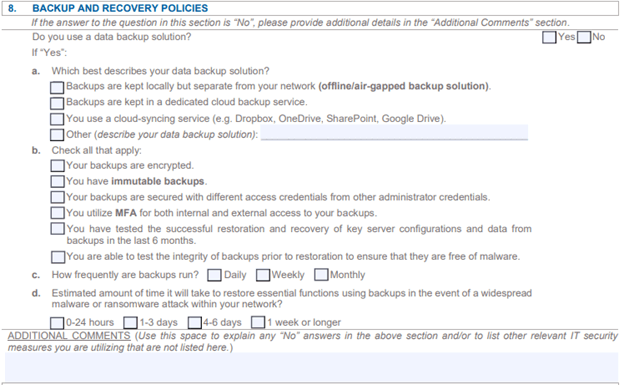
Fig 2: Example of a questionnaire in a cyber insurance application form
These are real risks that MSPs need to raise during conversations. If clients hesitate on any of these questions, it’s a clear signal that backup alone won’t cut it. They need a BCDR solution designed for speed, resilience and accountability.
Offer tiered business continuity and disaster recovery options
As we’ve seen, not all downtime is equal. MSPs should offer tiered BCDR solutions tailored to each client’s risk tolerance and operational priorities.
Not every workload needs to be restored within five minutes. However, for critical systems — such as payment processing, customer service platforms or enterprise resource planning (ERP) systems — speed is crucial. Align recovery times with the business value of the system being protected.
That’s where RTO and RPO come in:
- Recovery time objective (RTO): How quickly the system must be restored after an outage
- Recovery point objective (RPO): How much data loss is acceptable, measured in time
These aren’t just technical metrics — they represent business risk. A three-hour RTO might seem acceptable until the client realizes it means three hours of lost orders, idle staff or missed service windows. MSPs should tie RTO and RPO to what matters most.
When recovery targets are aligned with actual business priorities, clients can see exactly what they’re protecting and why it’s worth the investment.
How Datto BCDR helps MSPs deliver always-on business continuity
Downtime puts everything at risk. That’s why a reliable BCDR solution is critical. Datto BCDR is a purpose-built platform designed for MSPs to help their clients stay resilient in the face of disruption. By combining automated backup, instant failover and built-in backup verification, Datto eliminates downtime and keeps operations running — no matter what.
Here’s how Datto BCDR helps MSPs deliver operational continuity, swift recovery, stronger protection and greater client confidence:
- Automated backups: Datto backs up data as frequently as every five minutes. MSPs can minimize data loss while ensuring that a recent restore point is always available.
- Instant virtualization, locally or in the cloud: If a system fails, Datto can instantly virtualize it on a local appliance, in the cloud or both. This allows MSPs to restore operations in minutes — not hours or days.
- Automated backup verification: Every backup is automatically tested to confirm it boots successfully and that applications run as expected. MSPs can deliver peace of mind without manual effort.
- Flexible recovery options: Whether clients need to recover a single file, a folder or an entire server, Datto gives MSPs complete control over how recovery happens.
- FIPS 140-3 validated encryption: For MSPs serving federal, state or regulated industries, Datto’s SIRIS 6 appliances now include FIPS 140-3 Inside, enabling MSPs to meet strict compliance requirements.
Explore how Datto BCDR helps you keep your clients’ businesses resilient against any type of disruption.