Digital Specialists for Ticket Triage
Every IT team knows the drill.
A ticket comes in, but before anyone actually fixes the issue, the real work begins:
- How urgent is it?
- What kind of problem are we dealing with?
- Who is the right person to take it on?
- Do they have the bandwidth right now?
This is ticket triage, and it’s quietly draining your resources. In fact, many IT teams don’t realize just how much time this consumes. Your technicians spend up to 20-30% of their time not solving problems, but organizing them.
They are stuck in the weeds:
- Assessing priority levels
- Categorizing issues
- Determining ownership
- Cross-checking workloads against capacity
There’s no doubt it is essential work, but it isn’t the work your best people should be doing — and as ticket volumes grow, this becomes a bottleneck
- Response times slow down
- Routing becomes inconsistent
- Technicians get overloaded with administrative tasks
- SLAs are missed
What starts as a necessary process quickly becomes a growth bottleneck, limiting your team’s efficiency, scalability and ultimately the quality of service you deliver.
Introducing Digital Specialists for Ticket Triage
What if ticket triage could take care of itself?
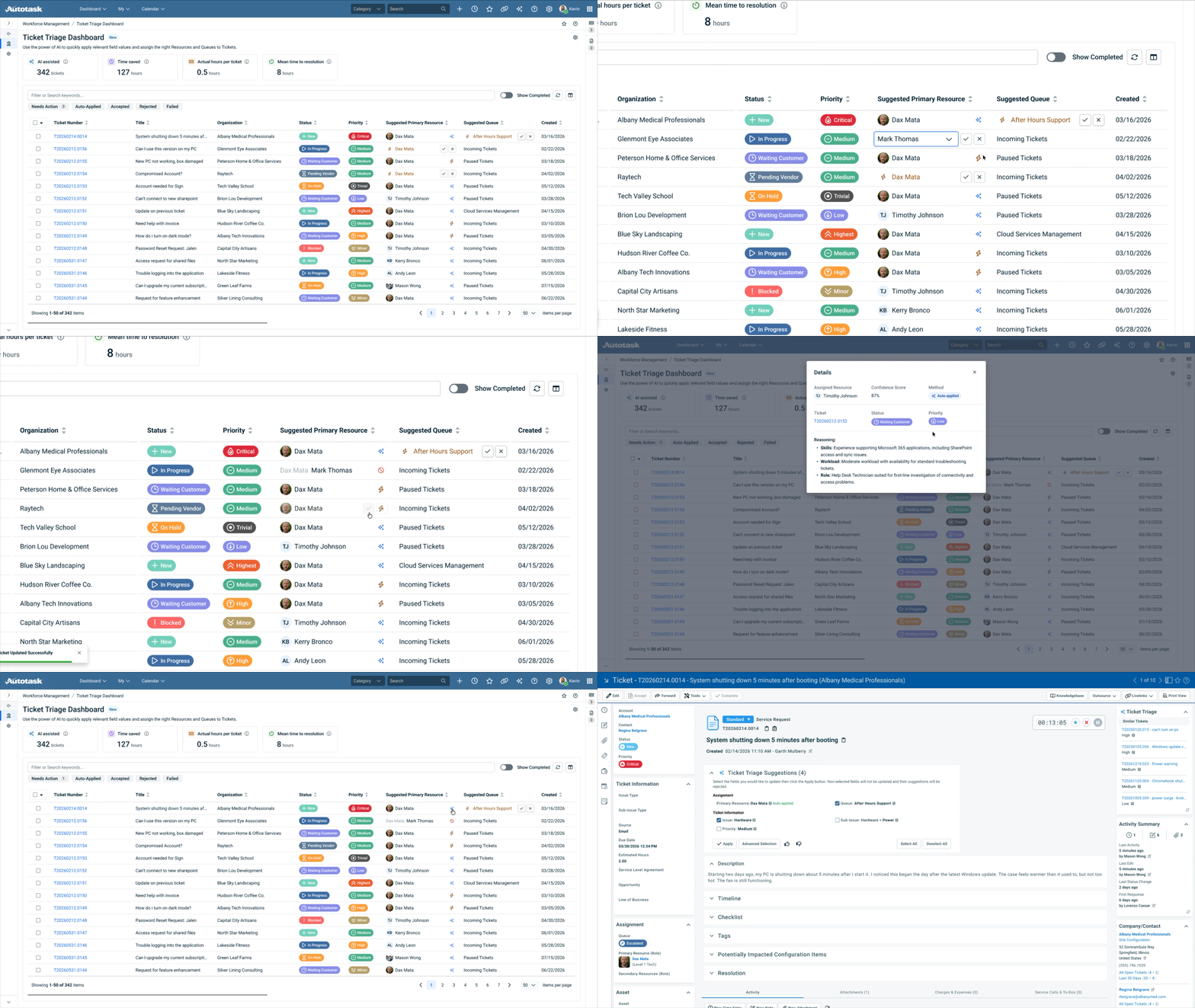
Powered by Kaseya Intelligence, our new Digital Specialists for Ticket Triage uses agentic AI to automate the manual work that slows your service desk.
Behind the scenes, it intelligently:
- Classifies ticket priority based on contextual urgency and impact severity
- Identifies issue type and sub-issue with precision using contextual signals
- Determines the required expertise and matches tickets to the right skillset
- Routes tickets to the best-fit technician based on workload and availability
Every ticket is assessed, matched and assigned autonomously, eliminating the need for manual intervention and reducing delays. As a result, your team spends less time organizing work and more time resolving issues, leading to improved efficiency and better service delivery.
Early access partner feedback and expected results
In March, we put this capability to the test with an early release across 25+ partners, along with Kaseya’s internal help desk and NOC teams.
The results are already pointing to a meaningful shift in how service desks operate. Here’s what they had to say:
“Around 20–30% of our tickets aren’t categorized correctly today, which creates downstream issues like billing inaccuracies. From what we’re seeing in early testing, the Digital Specialists for Ticket Triage could eliminate up to 80% of those errors.” — Koos Ligtenberg, Business Unit Director, Advisor ICT
“In just two weeks of implementation, we’ve seen a 90% decrease in mean time to assign.” — Gonzalo Carrilo, Sr. Manager, Managed Services, Kaseya
“Within one week, we’re seeing around 98% accuracy in issue and sub-issue categorization, dramatically reducing the need for manual review.” — Kim Drumm, Director of Business Process Management, Vitis Technologies
These early results highlight what is possible when triage is no longer a bottleneck, but a fully automated, intelligent process that scales with your business.
How intelligent triage transforms service delivery
The impact of Digital Specialists for Ticket Triage shows up across every stage of the ticket lifecycle, from intake to resolution, delivering measurable improvements in speed, accuracy and efficiency.
Smarter ticket intake and categorization
Today, most Kaseya Help Desk tickets come in via email, requiring manual effort to interpret and categorize each request. With Digital Specialists, that process becomes instantaneous.
Tickets are automatically categorized the moment they are created, with no human intervention required. This not only reduces manual workload but also significantly lowers Mean Time to Assignment (MTTA).
Skill-based routing instead of first-come, first-serve
Traditional ticket assignment often prioritizes availability over expertise, leading to inefficiencies and unnecessary handoffs. Digital Specialists for Ticket Triage changes that by routing tickets based on the technician’s skillset, workload and suitability for the issue.
This shift leads to higher First Contact Resolution (FCR) rates while eliminating ticket “bouncing,” where reassignment can add upwards of 20 minutes per ticket. The result is faster resolutions and a smoother experience for both technicians and your clients.
Precision through granular categorization
Early feedback from Kim Drumm and her team at Vitis Technologies highlights the power of going deeper than surface-level classification. By accurately identifying both issue type and sub-issue type, the system achieves around 98% categorization accuracy today.
This level of precision ensures tickets are not just categorized, but categorized correctly, setting the foundation for better routing and faster resolution.
Operational simplicity with structured queues
Another key insight from Kim Drumm’s team is the value of aligning workflows to clearly defined roles through structured queues.
With role-based queues such as Tier 1, NOC and Provisioning, tickets are assigned based on skillset and responsibility from the start. This creates clear ownership throughout the ticket lifecycle, reducing confusion, improving accountability and enabling teams to operate with greater consistency and control.
Digital Specialists for Ticket Triage, powered by Kaseya Intelligence
Triage is often mistaken for simple automation. It’s not.
What powers Digital Specialists is a tightly integrated combination of Kaseya Intelligence, data, governance and orchestration working together as a single system. The result is something fundamentally different from traditional AI tools.
At the core is a Hybrid Reasoning Architecture, designed to combine the language understanding of large language models (LLMs) with the precision and reliability of deterministic systems.
When a ticket enters the system, it is not handled by a single model. Instead, it moves through a reasoning mesh — a coordinated network of specialized agents, each responsible for a specific decision.
Two of these agents are powered by LLMs, where interpreting language and context is critical. The other two are deterministic, ensuring that calculations and decisions based on data remain precise and predictable.
The Impact Agent evaluates priority, issue type, sub-type and severity, replicating the judgment a technician makes when reading a ticket. This is LLM-powered because understanding context requires deep language comprehension.
The Skills Assessor determines the exact expertise and certifications needed to resolve the issue. This is also LLM-powered, as mapping problems to skills depends on nuanced interpretation.
The Smart Assigner ranks available technicians based on skill match, certifications and past performance. This is deterministic because ranking is mathematical and must remain consistent and reliable.
The Capacity Planner checks real-time availability, factoring in schedules, time zones and workload. This is also deterministic because availability is measurable and should not rely on approximations.
Four agents. Two distinct approaches. One coordinated decision.
Built-in critique for higher accuracy
There is also a fifth agent in this system, designed with a very different purpose: the Critique Agent.
It does not classify or assign tickets. Instead, it challenges the decisions made by the other agents using a separate model.
If the Impact Agent identifies a ticket as a high-priority outage, the Critique Agent re-evaluates that conclusion, questioning the signals, assumptions and potential gaps. This deliberate model diversity ensures that decisions are not reinforced by the same biases or blind spots.
The result is a system where every decision is validated before action is taken, helping drive production accuracy.
A system that learns with every ticket
What truly sets this architecture apart is not just how it makes decisions, but how it improves over time.
Every Digital Specialist operates on a continuous three-phase lifecycle: Learn, Triage and Review.
“Triage” is where decisions are made.
“Review” is the trust layer, where technicians can accept, reject or refine recommendations.
“Learn” is where the system evolves.
Each resolved ticket feeds back into Kaseya Intelligence. The system captures what was done, identifies the skills used and incorporates those insights back into the reasoning mesh.
Over time, your resolved tickets become a growing body of proprietary intelligence. Your technicians’ expertise becomes embedded in the system, continuously improving its accuracy and relevance.
This is not a generic AI trained on public data. It’s a living intelligence layer unique to your MSP that becomes smarter with every ticket closed.
And that creates a lasting advantage. While others may attempt to replicate the technology, they cannot replicate the data, context and experience your system accumulates over time.
Data is the foundation of great AI outcomes
AI is only as effective as the data behind it. When your data is clean and structured, automation becomes faster, more accurate and more confident. When it’s inconsistent or unclear, even the best systems slow down.
For ticket triage, this matters more than most realize. The way your team thinks it operates does not always match what your data reflects. For AI to scale effectively, your data model needs to align with your mental model of how work should flow.
Here are the key areas every service desk should evaluate:
- Priorities
- Issue and sub-issue types with contextual taxonomy
- Queues to help ensure tickets land where they belong
- Skills
Accurate skill mapping is what enables true skill-to-work matching. You can explicitly document your technicians’ skills based on what you know about your team or infer skills from historical ticket data and past resolutions. You can also leverage a curated system of 250 prebuilt skills, standardized to Information Technology Infrastructure Library (ITIL), IT service management (ITSM) and MSP operations. Together, this creates a reliable foundation for matching the right work to the right technician every time. - Ticket content
Ticket details act as semantic anchors, giving context and meaning to patterns in the data. The richer and more consistent this information is, the more effectively AI can interpret and act on it.
When these elements come together, triage stops being reactive and becomes intelligent, scalable and consistently reliable.
Redefining ticket triage for modern MSPs
What once took minutes per ticket now happens in seconds, without adding to your team’s workload.
- No more second-guessing priority.
- No more tickets bouncing between teams.
- No more overloading your best technicians.
Instead, every ticket is automatically routed to the right person at the right time, based on real context, skills and availability.
This is what efficient, scalable service delivery looks like.
Ready to see it in action? Request a demo today and experience how effortless ticket triage can be.